Hydronic load & flow reviews
We map BTU/hr targets, supply temperatures, and flow regulation windows to your slab assemblies so radiant comfort and pump energy are documented as an explicit trade-off, not an afterthought.

Engineering services
Application engineers help architects, mechanical contractors, and procurement managers align pipe sizes, ProPEX expansion fitting schedules, radiant loop lengths, and NSF/ANSI 61 letters before shop drawings freeze the hydronic package.
Service pillars
Each pillar is scoped to PEX plumbing and hydronic radiant systems—not generic construction consulting—so teams leave with SKU-level answers they can paste into Division 22 and Division 23 language.
We map BTU/hr targets, supply temperatures, and flow regulation windows to your slab assemblies so radiant comfort and pump energy are documented as an explicit trade-off, not an afterthought.
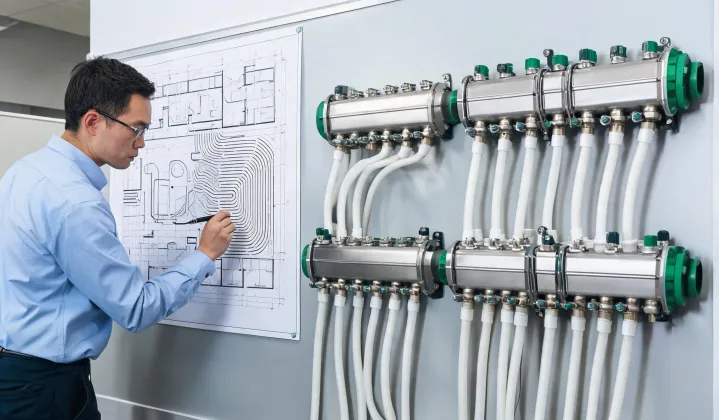
Expansion ring schedules, manifold port counts, and zone valve actuator notes are packaged so remodel phases can refresh circuits without opening finished floors.
NSF/ANSI 61, NSF/ANSI 14, IAPMO, and ICC-ES letters are cross-checked against your jurisdiction list for multifamily and healthcare risers.
Pre-insulated jacket thickness, joint kits, and burial depth notes help campus teams avoid field wrap gaps that create thermal bridging.
Project teams receive 25-year limited warranty language, tool kit IDs, and stocking guidance so facilities are not guessing after turnover.
Impact metrics
Numbers below reflect typical turnaround for PEX plumbing and radiant packages when pipe sizes, floor areas, and design temperatures arrive with the first inquiry.
Loop layouts, NSF letters, and manifold notes returned for active bid packages.
Projects that complete Uponor review notes before the first plumbing submittal cycle.
Jobsite and mock-up visits covering ProPEX technique, manifold balancing, and zone valve startup.
Global channels with documented PEX-a and radiant component availability.
When owners debate prefabricated bathroom pods with factory-set PEX branches versus traditional field-set manifolds, we document both sides: pods compress schedule and tighten quality control, while field-set manifolds preserve design flexibility for late unit mix changes and local subcontractor availability. Domestic sourcing versus imported specialty fittings is another recurring dispute—Buy America pathways and lead-time resilience often outweigh unit-cost savings when liquidated damages loom. Those conversations stay grounded in operating pressure windows, moisture vapor transmission around wet slabs, and service life expectancy for PEX-a under continuous hydronic duty cycles. Natural stone radiant overlays versus engineered underfloor assemblies likewise require different loop spacing and compressive strength assumptions; we publish both so architects can weigh aesthetics against dimensional stability without rewriting the entire mechanical narrative mid-bid.
Share pipe size, radiant floor area, design supply temperature, manifold count, and whether potable plumbing or district energy currently drives the package.